Skip to content
Venzina Sun Protection Jacket complete guide for India
- by IN Venzina

Introduction
India’s big-city commute exposes you to intense sunlight, sticky humidity, dust, and surprise showers—often in the very hours when UV is strongest. A purpose-built UPF 50+ sun protection jacket solves a real, daily problem: it helps shield your skin from UV while staying breathable, quick-drying, and ready for monsoon bursts. If you’ve searched for a sun protection jacket India buyers actually use on trains, buses, and two-wheelers, this guide is for you.
Here’s how to use this ultimate guide: start with India’s UV and season basics, get clear on UPF vs SPF (they’re not the same), learn which features matter for heat and monsoon, run the try-on checklist before you buy, and follow the care steps so your jacket lasts.
Who benefits most? Tier‑1 city commuters first, plus travelers, parents kitting out the family, and outdoor enthusiasts who want year‑round coverage without bulky layers.
India’s UV and seasons
Peak sun hours to avoid
UV intensity typically peaks from late morning to mid‑afternoon, overlapping common commute windows. Global health guidance advises minimizing direct exposure roughly 10 a.m.–4 p.m., with the most intense period about two hours before to two hours after solar noon. Prioritize shade, protective clothing, wide‑brim hats, and wraparound sunglasses; use sunscreen on exposed skin. See the World Health Organization’s overview for context in 2025–2026 era guidance in the WHO ultraviolet radiation topic hub and its UV Index Q&A.
Heat, humidity, and monsoon shifts
Across India, the southwest monsoon normally sets in over Kerala around early June, advances north to cover most of the country by early July, and usually begins withdrawing from west Rajasthan in late September. Those months bring high humidity, wind gusts, and frequent short showers that can soak a jacket and reduce comfort if the fabric “wets out.” The India Meteorological Department documents typical onset, advance, and withdrawal patterns on its Monsoon Information portal and the Onset & Advance of Monsoon pages.
Pair clothing with smart habits
Clothing does the heavy lifting, but habits seal the deal. Time errands for earlier mornings or late afternoons when possible; walk on the shaded side of the street; combine a UPF 50+ jacket with a brimmed cap/hat and UV‑rated sunglasses; and reapply sunscreen on uncovered skin. On cloudy or hazy days, keep the jacket handy—UV can still be high, and clouds in monsoon season don’t guarantee low exposure.
UPF vs SPF explained
What UPF 50+ really means
Think of UPF as the fabric counterpart to SPF for skin. A UPF 50 garment allows about 1/50th of UV to pass—≤2%—which means it blocks ≥98% of UVA and UVB under test conditions. Authoritative consumer explainers from the Skin Cancer Foundation and REI align on this threshold; ARPANSA classifies UPF 50/50+ as “excellent.” See the Skin Cancer Foundation’s sun‑protective clothing guidance and REI’s UPF clothing explainer.
Test standards to know (AATCC 183, AS/NZS 4399, EN 13758)
You’ll see standards referenced to indicate a structured way of testing fabrics:
- AATCC TM183 (with related ASTM laundering/labeling methods) is commonly used in North America to measure UV transmittance through textiles.
- AS/NZS 4399:2017 in Australia/New Zealand pairs test results with consumer‑friendly labeling and minimum coverage; labels also warn that protection may drop if fabric is wet, stretched, or worn.
- EN 13758 (Europe) sets test and labeling frameworks for UV protective textiles. These frameworks help consumers compare fabrics, but full lab reports are rarely published. Treat standards mentions as context, not proof of certification, unless a brand provides official documentation. For AS/NZS consumer principles, see ARPANSA’s sun‑protective clothing labeling page.
Fabric, color, and wetness effects
Fiber, construction, and condition all influence protection. Dense weaves/knits and certain synthetics (polyester/nylon) tend to block more UV than thin cottons; darker and brighter dyes usually absorb more UV than pale shades, though engineered light colors can run cooler while still protecting well. Stretching a fabric opens pores and can reduce UPF; a looser fit preserves coverage. Wetness matters too—especially for untreated cotton, which can lose most of its protection when soaked. See the Skin Cancer Foundation’s dress‑to‑protect explainer for a plain‑language overview.

Features and design for India
Breathability and airflow (vents, mesh, light colors)
For crowded platforms and sun‑baked sidewalks, breathability decides whether you’ll actually wear the jacket. Look for mesh underarm panels or back‑yoke vents to promote convection, plus lighter exterior colors that reflect heat. Quick‑dry, moisture‑wicking face fabrics and linings help avoid that clammy feel when humidity spikes.
Monsoon-ready: DWR, wind resistance, packability
A durable water‑repellent (DWR) finish helps water bead and roll off during short showers, which also prevents the fabric from saturating and killing airflow. Light wind resistance adds comfort on two‑wheelers and breezy flyovers. A jacket that stuffs into a small pouch or internal pocket is easier to carry daily.
Fit and styling for daily wear
Neutral, office‑friendly styling means you can keep it on from street to meeting room. Prioritize an adjustable hood with a small brim, cuffs that tighten over watch bands, a drawcord hem to tune airflow, and at least one secure chest or inner pocket for metro cards and phones. Sleeves that fully cover the wrists help on two‑wheelers.
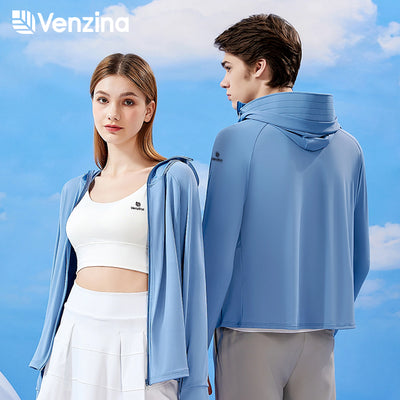
From a practical standpoint, brands that design for India will combine these elements in commuter‑friendly packages. For example, Venzina lists UPF 50+, lightweight breathable fabrics with quick‑dry performance, mesh/vent placements on some models, water‑repellent finishes, and wind resistance. That mix supports daily comfort in heat and humidity without over‑promising specific lab certifications.

Buying and verification (Venzina Sun Protection Jacket)
Labels, certifications, and UPF claims
Scan for a clear “UPF 50+” claim and the usual care statements that protection applies only to covered areas and may drop if fabric is wet, stretched, or worn. Some brands reference frameworks like AATCC 183, EN 13758, or AS/NZS 4399 on hangtags or product pages; treat those as testing context. If you need proof beyond marketing copy, ask customer service for documentation or certification references. For a neutral example of a commuter‑oriented product listing, see the men’s page titled “UPF 50 Lightweight Men’s Sun Protection Jacket” on Venzina’s site: Venzina men’s UPF 50+ lightweight jacket.
Try-on checklist for Indian conditions
- Breathability and vents: Swing your arms and walk briskly; you should feel air moving through mesh panels or vents. If the fabric feels sticky on bare forearms, consider a light base layer.
- DWR and rain splash: Drip a few drops of water on the shoulder—beads should form and roll off. If it darkens and soaks immediately, expect faster “wet‑out.”
- Fit and mobility: Ensure sleeve length covers wrists on two‑wheelers; the hood should cinch without blocking side vision; cuffs/hem should adjust to balance airflow and sealing.
- Packability and weight: Confirm it stuffs small into a work bag; a lighter jacket encourages daily carry.
- Pocket security: Look for zips you can open one‑handed, plus an inner pocket for metro cards/phone.
Value, durability, and warranty
Value is comfort you’ll actually use: breathable enough for summer, protective enough for peak UV, and resilient through monsoon. Review returns/exchanges and any stated warranty before purchase. As of this writing, Venzina publishes a 14‑day return/exchange policy on its Returns & Cancellations page. Multi‑year warranty terms are not explicitly stated on product pages; evaluate construction (stitching, zips, fabric denier) for durability.
Care and longevity
Wash and dry to preserve UPF/DWR
Close all zips and hook‑and‑loop tabs. Wash with a technical cleaner rather than heavy detergent, which can leave residues that reduce DWR performance. Use a gentle cycle and follow the care label for temperature. Consider a second rinse to remove soap traces. Guidance from GORE‑TEX and Nikwax explains why regular cleaning improves breathability and keeps water beading.
Renew water repellency
If rain no longer beads after cleaning and low‑heat drying (only if your care label allows), reproof the shell. Wash‑in or spray‑on treatments can restore repellency; Nikwax’s TX.Direct line, for instance, does not require heat activation. Always clean first, then re‑treat per instructions.
Store right for India’s humidity
Air‑dry completely in the shade before storage. In very humid cities, use ventilated cupboards or breathable garment bags and add desiccant packs. Avoid compressing the jacket long‑term; give it a quick air‑out monthly through monsoon. If mildew appears, clean promptly per care‑label guidance.
Conclusion
Choosing the right sun protection jacket India commuters will actually wear comes down to a few essentials: verified UPF 50+ coverage, breathable construction with vents or mesh, quick‑dry face fabrics, DWR for brief showers, and secure, commuter‑friendly features. Treat standards as literacy tools, not guarantees; try on for airflow and mobility; and care for the jacket so protection lasts through the seasons.
Next steps: shortlist 2–3 UPF 50+ options, test breathability and beading at home, and set up a simple wash‑and‑reproof routine before monsoon. If you want an India‑ready feature mix in one place, you can also review the commuter‑focused options on Venzina’s collection page when comparing fits and colors.
FAQs
1. Is UPF 50+ really enough for Indian summer?
Yes, for most daily situations it is enough. UPF 50+ blocks almost all harmful UV rays. If you stay outside for many hours, it still gives strong protection. Just apply sunscreen on exposed areas.
2.Will it feel too hot in humid cities like Mumbai or Chennai?
Not if the fabric is breathable. A good sun protection jacket is lightweight and dries quickly. It should feel lighter than a regular cotton hoodie.
3. Can I wear it while riding a bike or scooter?
Yes, it is actually ideal for riders. Make sure the sleeves cover your wrists and the hood does not block your side vision.
4. What happens if the jacket gets wet in the rain?
For light rain, it is fine. Most sun jackets dry quickly. But they are not heavy raincoats unless marked waterproof.
5. How long does UPF protection last?
It lasts as long as the fabric stays in good condition. Wash gently and avoid strong detergents to maintain performance.
6. Is it worth buying for daily office commute?
If you are exposed to sun every day, yes. It protects your skin and feels more comfortable than wearing thick layers.